 FaceWise
Facial emotion analysis, second by second
Facial emotion analysis measures reactions from facial expressions: a model watches a recording of the face and estimates, moment by moment, which emotions it shows. FaceWise, a browser-based tool for testing emotional reactions, does this with respondents who watch your ad, trailer or packaging design.
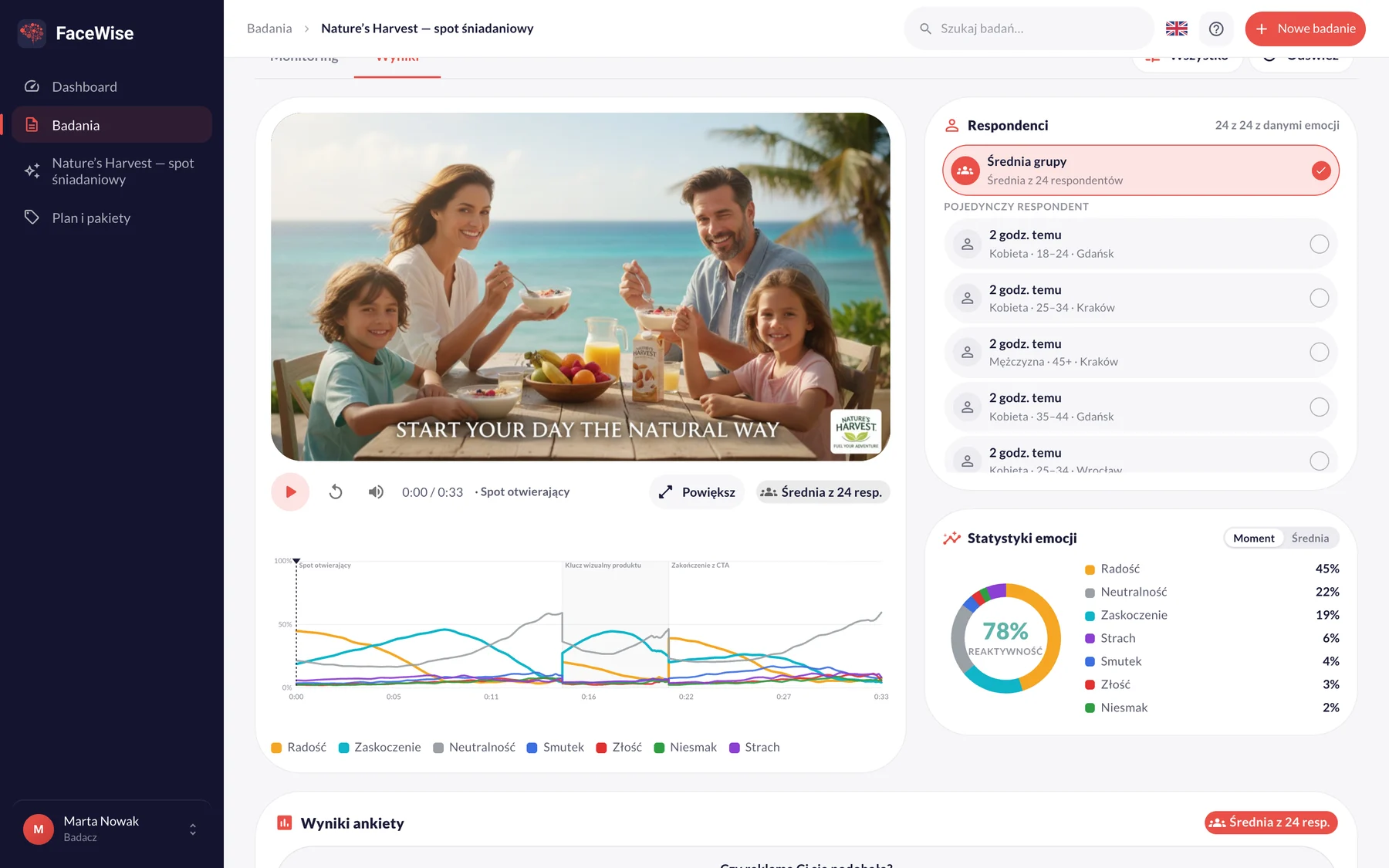
The result is a set of curves for seven emotions laid over the timeline of your material. You see the second people smiled and the second their face went blank.
What exactly does FaceWise measure?
FaceWise recognises 7 emotion categories:
The face is analysed every half second of the recording, which means two samples per second of material. Each sample gets a probability distribution across all seven categories rather than one label. That lets you see mixed reactions too: joy with a touch of surprise at the first product shot looks different from plain joy at the logo.
The model is our own, built at Affexy, and it runs on servers in the European Union.
How does a study work, step by step?
- Upload your material. Video (MP4, MOV), an image (JPG, PNG), text, or a link to a web page or a YouTube video. Add demographic questions and the questions respondents will see after the material.
- Send a link or a QR code. By email, on Slack or on a poster. Respondents open it on a laptop or phone, allow the camera and watch. No account, nothing to install.
- Read the result. Emotion curves synced with your material, the group average or a single person, with the survey answers alongside.
How do you read the emotion chart?
The material sits on top and the emotions run underneath. Click any moment on the chart to see what respondents were watching in that second.
- Switch between the average for the whole group and a single respondent.
- Filter by gender, age and survey answers, for example people who say they would buy versus people who say they wouldn't.
- Moments where the model found no face leave a gap in the chart. FaceWise doesn't guess values it didn't measure.
Why measure the face when you already have a survey?
Asked after the fact, respondents rationalise. They say what sounds right and squeeze their impression of the whole spot into one rating from 1 to 5. The face reacts the moment something happens on screen.
That's why FaceWise keeps both sources in one study: demographics and post-exposure questions sit right next to the emotions. You see what people said and what their face showed, and you can check whether the two agree.
What is webcam facial coding?
Facial coding is the family of methods that read emotions from movements of the facial muscles. It used to be done by trained coders, frame by frame, using the FACS system described by Paul Ekman and Wallace Friesen. Webcam facial coding automates it: FaceWise codes every respondent's face from an ordinary laptop or phone camera, with no lab and no special hardware.
For researchers who want the method in their own experiments, the page for universities covers data export and what to write in the methods section.
What affects the result, and what the analysis can't tell you
Lighting, camera angle and image quality all affect the result. A single frame from a single person can mislead, so you read the chart across the group and over time.
- The analysis shows what is visible on the face. It doesn't tell you what someone thinks, and it doesn't detect truth or lies.
- FaceWise makes no diagnoses and is not meant for clinical use.
- It is not for assessing employees or students either. The AI Act prohibits emotion recognition in the workplace and in education. Details are on the security and AI Act page.
What is facial emotion analysis used for?
Ad pretesting
A spot, pre-roll or trailer before it airs. See the second viewers react and the second they lose interest.
Packaging testing
A packaging design or key visual shown to respondents before it goes to print.
Academic research
Facial expression experiments without a lab, with export to SPSS or R.
Pricing
PLN 99 net per month for 200 respondents. The first 14 days are free.
Before you sign up, you can try the model on yourself. The demo on the home page runs in your browser: the camera image never leaves your computer and nothing is saved. In a real study the respondent's recording goes to a server in the EU, because that's where the analysis runs.
Frequently asked questions
How many emotions does FaceWise recognise?
Seven categories: joy, surprise, sadness, anger, fear, disgust and neutral. For every sample the model returns a probability distribution across all seven, not a single label.
How often is the face analysed?
Every half second of the recording, so two samples for each second of material. A one-minute spot gives you 120 samples per respondent.
Do respondents need to install anything?
No. They open the link in a browser (Chrome, Safari, Edge or Firefox) on a laptop or phone and allow the camera. No account needed.
How accurate is facial emotion analysis?
We don't quote a single accuracy figure. Lighting, camera angle and image quality all affect the result, so you read the chart across the group and over time, not from a single frame.
Where to go next
Ad pretesting before you buy media
Ad pretesting in FaceWise: upload a spot, send a link and see viewers' emotions second by second next to their survey answers. 14-day free trial.
Read morePackaging testing before it hits the shelf
Packaging testing in FaceWise: show a design or key visual, respondents view it from home and you see their emotions next to their survey answers. 14 days free.
Read moreOnline psychology research software with facial expression measurement
FaceWise for universities: facial emotion experiments without a lab, a survey in the same study, CSV export for SPSS and R, and sub-licences for your team.
Read moreFaceWise pricing: start with 14 days free
FaceWise pricing: the FaceWise plan at PLN 99 net per month with 200 respondents, Pro at PLN 899 net and Enterprise on quote. 14 days free.
Read moreRespondent data security: consent, the EU and clear limits
Respondent data security in FaceWise: consent before recording, EU servers, access for your team only and the limits set by the AI Act. The demo sends nothing.
Read moreWebcam emotion analysis tools: FaceWise, iMotions, RealEye and others
FaceWise, iMotions Online, FaceReader Online, RealEye, Tobii and EyeSee side by side: pricing, facial coding, eye tracking, surveys and data. As of 2026-10-21.
Read moreContact FaceWise: write and we will reply
Contact FaceWise: leave your email and a message and we will reply to that address. Questions about Enterprise, university licences, rollout and invoices.
Read moreWebcam emotion test: try it on yourself
Free webcam emotion test in your browser. The FaceWise model reads 7 emotions from your face live, and the video never leaves your computer. No sign-up needed.
Read moreSee what your audience
actually feels.
14 days free with the full 200-respondent package. You pay only once you choose a plan.